
%20(2).png)
User Journey visibility from the outset
Standardised, reusable monitoring journeys. Owned by engineering teams
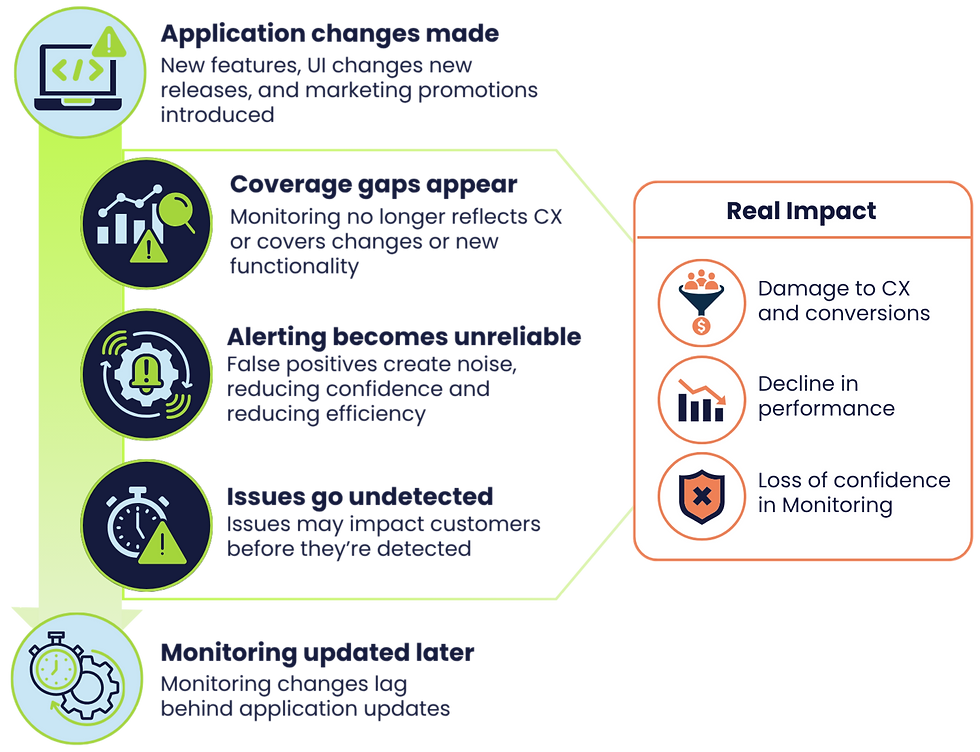
Application functionality changes continuously, but customer journey monitoring is often configured separately or added after release. Different teams use different tools and processes. Monitoring updates rely on handoffs. monitoring can quickly fall behind the journeys customers are experiencing.
A monitoring-as-code approach delivers visibility from the outset, bringing user journey monitoring closer to the development process. Instead of treating monitoring as a separate configuration task, teams define critical customer interactions in a clear, structured and reusable format.
_edited.png)
Standardised and reusable
JourneyScribe uses declarative YAML to describe the actions customers take and the outcomes they should see.
This provides a consistent way to define journey tests across teams, products and environments. Approved journey patterns can be adapted and reused rather than recreated each time.
Managed alongside application change
Because journey definitions are clear, reusable and human-readable, engineering teams can maintain them alongside the services and functionality they monitor.
When a customer journey changes, its monitoring definition can change with it, reducing the risk of coverage becoming disconnected from the application.
Visibility from the outset
Customer journey assurance does not have to begin after deployment.
Journey definitions created to validate customer-facing functionality during QA, UAT and release can become reusable assets across the software development lifecycle. The same journey logic can then continue into production monitoring where appropriate.
Built for modern workflows
JourneyScribe is designed to fit modern development, release and CI/CD workflows.
Structured definitions make journeys easier to create and maintain.
Because they're written in a clear, standardised format, they're suited to automation and AI-assisted tools to generate, maintain and adapt in the future.
A code-driven approach to User Journey Monitoring
Customer journey monitoring as code brings journey monitoring into modern engineering workflows. JourneyScribe turns customer journeys into structured, reusable definitions that can be maintained alongside application change and incorporated into development, release and observability processes.
One JourneyScribe test. Multiple QA signals.
QA Teams need to validate the same customer-facing functionality or journeys from several angles. A single JourneyScribe run can support multiple QA processes, without treating each as a separate activity.
Individual QA tests can pass, but the customer journey can still fail when functionality, data, APIs or third-party services come together.
JourneyScribe helps QA teams check:
-
whether a core path is working as a smoke test
-
whether a customer-facing task meets the expected UAT outcome
-
whether a recent change has caused a customer-facing regression
-
whether connected systems work together from the customer’s perspective
-
where in the journey a failure occurs
-
how the journey performs across each step
And the same test can continue into live monitoring after going live
.png)
Define journeys once. Adapt and reuse across teams.
A code-driven approach makes it easier to establish common journey structures, naming conventions and validation patterns across teams.
Monitoring becomes a shared, reusable delivery asset rather than a separate activity added at the end.
This can help organisations:
-
improve consistency across products and delivery teams
-
reuse approved journey definitions
-
reduce gaps caused by manual handoffs
-
establish visibility of customer journey experience earlier
-
keep monitoring aligned with frequent releases
-
speed resolution when journeys fail

From simple tasks to complete journeys
JourneyScribe is not only for longer end-to-end user journeys. It can be used to validate smaller customer-facing tasks, such as a login step, form submission, account task, API-supported flow or a specific branch of logic.
The value is not the length of the journey, it's repeatable validation of customer outcomes.
That means engineering teams can use JourneyScribe to monitor anything from short, focused interactions to broader end-to-end journeys.

Clear evidence when incidents occur
JourneyScribe gives teams more than a pass or fail result.
It helps show:
-
Live status on Wallboard
-
Video replay of the customer-facing experience
-
Pinpoint where the journey or task failed
-
Component breakdown for diagnostics
-
Performance graphs across the test
-
Whether the failure impacts users
With video replay and diagnostic evidence, engineering teams can easily investigate issues and reduce MTTR.
Reusable monitoring journeys across the lifecycle
A journey created to test a customer-facing task before release does not necessarily have to be recreated for production. JourneyScribe supports a more continuous approach, where journey logic can be reused and adapted across development, QA, release and live monitoring.
This reduces duplicated effort and creates a clearer link between what teams tested before release and what the organisation continues to monitor afterwards.
.png)
