Online Kit Launch traffic is predictable. Launch-day performance isn’t.
Updated: Feb 19
Every club knows what kit launch day looks like. Traffic spikes sharply. Fans arrive from email and social. Journeys are short, focused and high intent. Conversion rates jump.
None of that is surprising. What’s harder to predict is how the platform behaves once that demand concentrates into minutes rather than hours.

When thousands of fans move quickly toward checkout at the same time, even small weaknesses surface fast. Readiness isn’t about knowing traffic will spike, it’s about being confident that real-world demand won’t compromise performance or fan experience.
Based on our work supporting Premier League clubs, a few patterns repeat.
1. Testing volume but not behaviour
Many teams test for peak traffic without reflecting how that traffic behaves and which journeys fans actually take.
Launch traffic isn’t broad browsing. It’s highly focused and high intent. A disproportionate number of users land on the kit page and head straight to checkout, often alongside dynamic and personalised content. A smaller number of users follow more browser based journeys and a number include personalisation tools as a part of their route across the store.
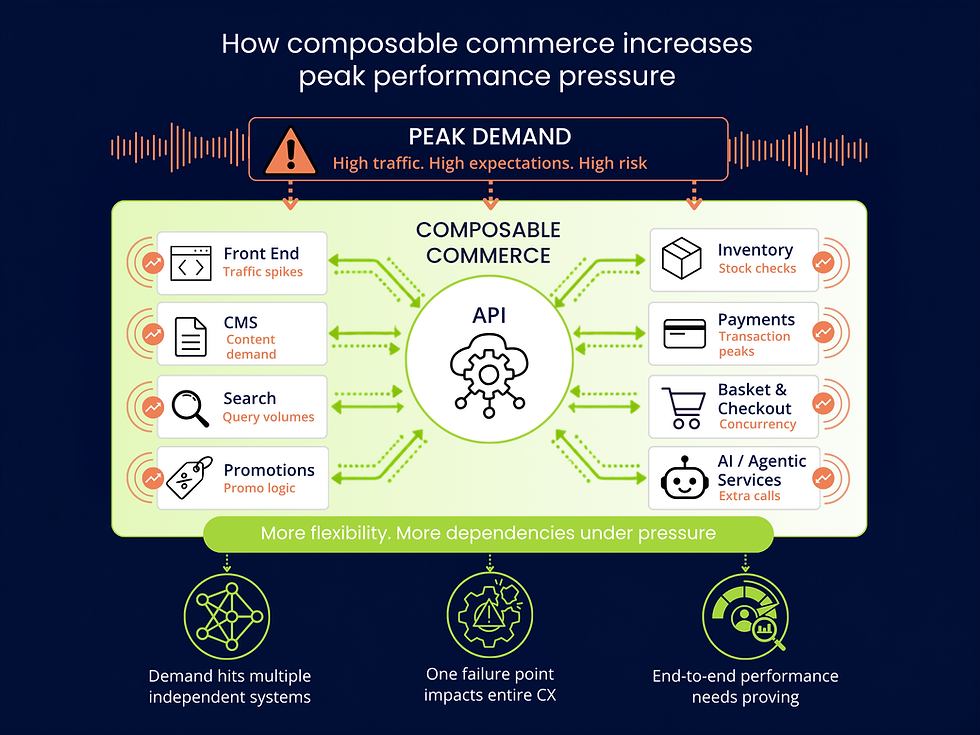
Increasingly, these journeys include AI-driven recommendations and dynamic merchandising, which introduce additional logic behind the scenes.

Impact: Tests appear to pass, but once fans start buying, checkout and payment steps experience concurrency levels they weren’t stressed for. Slowdowns and timeouts surface precisely where revenue is generated.
2. Autoscaling that reacts, just not quickly enough
Autoscaling is often treated as a safety net. In reality, scaling frequently lags behind sudden spikes. Systems may technically be capable of handling the demand, just not at the speed required when traffic arrives in sharp bursts.
Impact: Delivery times increase and widespread errors occur during the earliest, highest-visibility window of launch. Pages slow before additional capacity comes online, affecting conversion at the most critical moment.
3. Checkout pressure underestimated
Landing pages and product pages often hold up under Load Testing. The strain builds deeper in the journey.
With elevated conversion rates, far more users reach checkout at the same time than on a normal trading day. Stock validation, payment logic and confirmation flows come under concentrated pressure.
Impact: Browsing looks healthy, but failures appear at the point of purchase — leading to abandoned baskets and lost orders while fans are actively trying to buy.
4. Third-party behaviour under pressure
Payments, 3DS, address lookup, personalisation and CDN services all sit inside the buy journey.
Under peak load, small increases in latency across these integrations compound quickly. The core platform may appear stable, but the end-to-end experience slows as each dependency adds delay or worse causes errors.
Impact: Checkout performance degrades gradually rather than failing outright, increasing retries, duplicate attempts and quiet revenue loss.
5. Safeguards introduced too late
Queues, waiting rooms and bot controls are often added close to launch as protective measures.
If they aren’t configured and exercised properly under realistic conditions, they can behave unpredictably once real demand hits.
Impact: Instead of smoothing traffic, safeguards introduce friction, or fail to activate effectively, damaging fan experience at the worst possible time.
AI adds another layer of unpredictability to online kit launch performance
Modern kit launches don’t just involve more traffic, they involve smarter journeys.
AI-driven merchandising, fraud decisioning and dynamic content introduce additional calls and processing behind the scenes. Under concentrated demand, these systems don’t always behave as expected.
The result isn’t always a dramatic failure. Often it’s subtle performance erosion that only appears once real fans start buying.
It’s not traffic volume. It’s traffic behaviour.
Most digital teams understand kit launch traffic patterns.
The gap rarely sits in awareness. It sits in how realistically demand is modelled and exercised across the entire system, including checkout, third parties and safeguards.
And that’s before you factor in caching behaviour, marketing campaign timing or personalisation logic.
Further Resources
We’ve summarised a complete set of common kit launch preparation pitfalls, along with practical ways to reduce the risk, in a short guide based on our work with Premier League clubs.
Discover how thinkTRIBE can help your football club ensure a succesful launch or just get in touch.